PART 3
For seventy-three years, I had believed there were certain things a mother should never have to hear from her child. I’d survived losing my parents. I’d survived the long, terrible months when Raymond’s heart began failing. I’d survived burying the man who’d held my hand for forty-eight years.
But nothing had prepared me to sit at my own kitchen table and hear my only son admit that someone had prepared a medical report about me without ever examining me. “Nobody, Mom.” Mark’s words seemed to settle between the cups of tea and untouched banana bread. I looked at him. Then at Alicia. Then at Harold Bennett, the attorney Raymond had trusted with nearly every important decision we’d made.
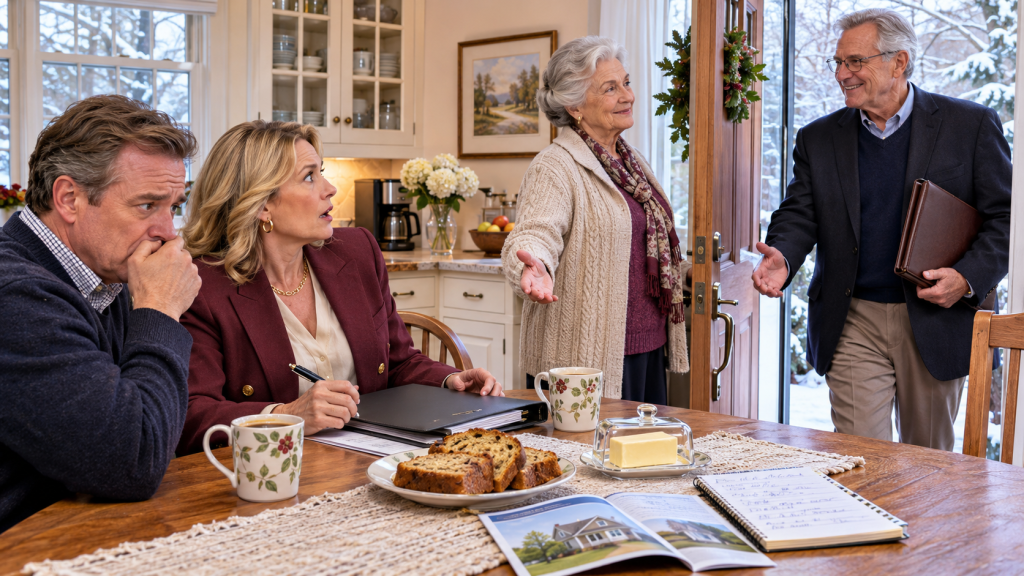
“What does that mean?” I asked. Mark covered his face. Alicia straightened in her chair. “Dorothy, you’re making this sound much worse than it is.” I turned toward her. “Then explain it.” She folded her arms. “We were simply preparing for the possibility that you might need assistance.” I looked at the envelope in Eleanor’s photograph. “Assistance with what?” “With your affairs.”
“My affairs?” Alicia sighed. “The house. Your finances. Your long-term care.” I took a slow breath. “Alicia, I made breakfast this morning. I paid my bills yesterday. Last week, I drove myself to the grocery store.” She gave me a patient smile. “That’s wonderful, Mother D. But older people can seem perfectly capable while making poor decisions.”
For a moment, I could barely believe what I was hearing.
Then I asked quietly, “And who gets to decide whether my decisions are poor?”
She looked toward Mark.
He didn’t raise his head.
And that silence told me something important.
My daughter-in-law didn’t want to help me make decisions.
She wanted to make them for me.
Harold extended his hand.
“May I examine the letter, Alicia?”
She hesitated.
“It’s private.”
He looked at her steadily.
“Dorothy is the person named in the document. If you intend to rely on it to affect her rights, she is entitled to understand what it contains.”
Alicia’s smile disappeared.
Mark finally spoke.
“Just give it to him.”
She turned toward him.
“Mark!”
“Give him the letter.”
For the first time that morning, my son sounded frightened.
Alicia reached into her handbag and removed the envelope.
She placed it on the table.
Harold opened it carefully.
Inside was a single-page report printed on white stationery.
He read the heading.
Then his expression changed.
“Dorothy, have you ever been evaluated by Dr. Leonard Price?”
I frowned.
“No.”
“Have you ever visited the Lakeshore Cognitive Wellness Center?”
“Never heard of it.”
Harold looked at Mark.
“Who obtained this?”
My son swallowed.
“Alicia said her cousin could arrange it.”
I stared at him.
“Her cousin who works at Silver Meadows?”
He nodded.
Alicia leaned forward.
“It’s just a preliminary assessment.”
Harold studied the page.
“An assessment ordinarily requires actual evaluation. This document claims Dorothy demonstrated significant memory impairment during an in-person appointment.”
I looked at him.
“But I wasn’t there.”
“I understand.”
He continued reading.
Then paused.
“There’s also a signature.”
My stomach tightened.
“Whose?”
“Yours.”
I held out my hand.
Harold passed me the document.
At the bottom was my name.
Dorothy Whitmore.
The signature looked familiar.
Too familiar.
It resembled the way I’d signed Christmas cards years ago, before arthritis changed the shape of my handwriting.
I stared at the page.
Then whispered, “That isn’t how I sign anymore.”
Mark looked up.
Alicia crossed her arms.
Harold leaned closer.
“What do you mean?”
I opened the kitchen drawer and removed my checkbook.
I signed my name on a blank sheet of paper.
My letters were smaller now.
The D had a shorter loop.
The final stroke of Whitmore stopped sharply instead of curling underneath.
I placed the signatures side by side.
“Raymond used to tease me about that old flourish. I stopped making it after my hand started hurting.”
Harold examined both.
Then looked at Alicia.
“Where did you obtain the signature used on this report?”
She didn’t answer.
I thought about the documents in the folder.
The assisted-living brochure.
The proposed transfer.
The medical letter.
Then something occurred to me.
“Mark, when you brought me those flu shot forms, did they include other pages?”
His face changed.
I stared at him.
“Son?”
He swallowed.
“I didn’t know exactly what Alicia had attached.”
My heart tightened.
“But you knew there were additional pages?”
He looked down.
“Yes.”
For a moment, the room was silent.
Then I whispered, “You watched me sign papers without explaining what they were.”
Mark began crying.
And I realized that my son hadn’t merely failed to protect me.
He had helped create the circumstances in which I might unknowingly surrender my rights.
Harold placed the documents in a neat stack.
“Dorothy, I recommend we preserve these for independent examination. We should not assume their legal effect without reviewing the originals and verifying their source.”
I nodded.
He turned toward Mark and Alicia.
“No further use should be made of documents purporting to grant authority over Dorothy’s affairs unless their authenticity and legal validity are established.”
Alicia stood abruptly.
“This is ridiculous!”
Eleanor, who had remained beside the kitchen doorway, folded her arms.
“What’s ridiculous is planning to move a woman out of her house so you can buy a boat.”
Alicia’s face reddened.
“That conversation was private!”
I turned toward her.
“Was it?”
She stared at me.
I reached for my grocery notepad.
The pages were covered with times and quotations from the accidental call.
7:19.
7:21.
7:26.
7:31.
I slid it across the table.
“I heard everything.”
Mark’s face went pale.
Alicia looked down.
I continued.
“The brochure. The realtor. The lake trip. The boat.”
My throat tightened.
“And the part where you told my son to pretend to be sad.”
Eleanor gently placed her hand on my shoulder.
Alicia looked toward the door.
Then back at me.
“You were listening to a private conversation?”
I almost laughed.
“You called me.”
She opened her mouth.
Then closed it.
“And when I realized what you were planning,” I continued, “I wrote it down.”
For several minutes, nobody spoke.
Then Mark whispered, “Mom, I didn’t want it to happen this way.”
I turned toward him.
“What way did you want it to happen?”
He rubbed his forehead.
“I thought we’d talk to you.”
I looked at the unsigned transfer papers.
“By taking my glasses away?”
His face crumpled.
“Mom—”
“By telling a care facility I couldn’t manage my own affairs?”
He covered his face.
“Please.”
I felt tears rising.
“Mark, you knew I wanted to stay in this house.”
He nodded.
“Your father and I chose it together.”
His shoulders shook.
“We planted the maple tree in the front yard the spring you were born.”
Tears slid down my cheeks.
“Your first bicycle is still hanging in the garage.”
Mark began crying.
“And you were going to sell all of it without asking me.”
He couldn’t answer.
I looked at him for a long moment.
Then said the words I’d been afraid to say since Raymond died.
“Son, I know you love me.”
Mark looked up hopefully.
“But I don’t think you’ve been treating me like someone you love.”
His expression collapsed.
Alicia gathered her handbag.
“We’re leaving.”
Mark remained seated.
She glared at him.
“Now, Mark.”
He wiped his face.
“Alicia, stop.”
The room went silent.
She stared at him.
“What?”
He looked toward me.
Then at the documents.
“I didn’t think it would go this far.”
Alicia laughed bitterly.
“Don’t start acting innocent.”
He stood.
“You told me it was just paperwork to make things easier.”
Her expression hardened.
“And you agreed because you wanted the money!”
I felt cold.
Mark stared at her.
She continued.
“You wanted to pay off the credit cards. You wanted that boat as much as I did.”
Harold quietly closed his folder.
Eleanor looked toward me.
I sat very still.
Debt.
There it was.
The word that had apparently been hiding underneath all their concern.
I turned toward my son.
“How much do you owe?”
He stared at the floor.
“Mom, it’s complicated.”
I waited.
“Mark.”
Finally, he whispered, “A little over ninety thousand.”
My stomach tightened.
“Ninety thousand dollars?”
He nodded.
Alicia threw up her hands.
“And that’s why we need to be practical!”
I looked toward her.
“Practical?”
She sighed.
“You don’t need this enormous house.”
I stared at her.
“And you do need a boat?”
She looked away.
For the first time that morning, I understood just how deeply their plans depended on treating my home as though it were already an inheritance.
After Mark and Alicia left, the house became very quiet.
Eleanor collected the cups.
Harold remained at the table.
I stared at the banana bread.
Nobody had eaten a single slice.
“Dorothy,” Harold said gently, “we should review your existing estate documents and financial authorizations.”
I nodded.
“Of course.”
He continued.
“We should also establish whether the questionable medical report or any alleged authorization has been submitted to another institution.”
My hands tightened around the teacup.
“Could they really have put me in Silver Meadows?”
He answered carefully.
“Not merely by presenting unsigned transfer papers or an unverified report. Your consent and legal rights matter. But we need to determine whether anyone attempted to misrepresent your wishes or capacity.”
I closed my eyes.
For four years, I’d been learning to live without Raymond.
I’d figured out how to handle the furnace when it stopped working.
I’d learned which mechanic wouldn’t overcharge me.
I’d opened my own investment statements.
I’d even joined a book club.
And all that time, my son and daughter-in-law had apparently been discussing how to convince strangers that I was incapable of making decisions.
I looked at Harold.
“Then let’s make sure nobody can do it.”
He nodded.
“We’ll take the necessary steps.”
That afternoon, Eleanor stayed for lunch.
We reheated soup.
Then sat beside the kitchen window.
The maple tree outside had begun turning gold.
Raymond loved autumn.
He used to say the trees were showing off before winter.
Eleanor watched me quietly.
“Dot, there’s something I should’ve mentioned.”
I turned toward her.
“What?”
She hesitated.
“I’ve seen Bruce here more often than twice.”
My stomach tightened.
“The realtor?”
She nodded.
“Three times last month.”
I frowned.
“That’s impossible. I was home.”
“Not every time.”
I looked at her.
Eleanor continued.
“One afternoon, while you were at book club, Mark came by with Bruce. I saw them measuring the side yard.”
My fingers went cold.
“Measuring?”
She nodded.
“Bruce walked around taking pictures.”
I stared toward the window.
For a moment, I imagined two men standing in Raymond’s garden, calculating what my home might be worth without once asking whether I intended to sell.
Eleanor took my hand.
“I thought you’d asked them to look at repairs.”
I shook my head.
“No.”
She swallowed.
“I’m sorry I didn’t mention it sooner.”
I looked at her.
“Don’t apologize for something you didn’t know was wrong.”
Then I paused.
“But if you remember anything else, tell me.”
She nodded.
“I will.”
The following morning, Harold called.
“Dorothy, I’ve been reviewing the property records.”
I sat straighter.
“And?”
“No transfer has been recorded. Your ownership remains unchanged.”
I exhaled slowly.
“Thank goodness.”
“But there’s something else.”
My stomach tightened.
“What?”
“A preliminary listing agreement was prepared by Bruce’s office.”
I stared at the wall.
“A listing agreement?”
“Yes.”
“For my house?”
“Yes.”
I swallowed.
“Did someone sign it?”
Harold hesitated.
“The copy we’ve obtained bears what appears to be your name.”
For a moment, I couldn’t speak.
Then I whispered, “Harold, I never signed a listing agreement.”
“I understand.”
My hands began trembling.
He continued.
“We’ll request the complete records and determine whether the document was submitted or relied upon.”
I looked toward Raymond’s photograph on the mantel.
A sudden memory came back to me.
The afternoon Alicia insisted on helping me organize my paperwork.
She’d carried a stack of old documents into the dining room.
She said she was sorting things.
I remembered feeling grateful.
Now I wondered what she’d actually been doing.
“Harold,” I whispered, “I think Alicia may have copied some of my old signatures.”
He was quiet.
Then said, “Tell me everything you remember.”
Two days later, I met Harold at his office.
He’d arranged for us to review the documents alongside a financial protection specialist.
We examined the listing agreement.
The medical report.
The proposed power-of-attorney papers.
And the assisted-living application.
Each carried information about me.
My name.
My date of birth.
My address.
Even the name of Raymond’s old employer.
Some details were accurate.
Others were wrong.
The assisted-living application listed my emergency contact as Alicia.
Mark was named as the primary financial representative.
My own telephone number was missing.
I stared at the page.
“Why wouldn’t they include my number?”
The specialist answered gently.
“We can’t determine intent from that omission alone, but it would be important to establish who completed the form.”
I nodded.
Then Harold pointed toward another section.
“Dorothy, do you recognize this bank account?”
I looked down.
It was an account ending in 6814.
I frowned.
“No.”
Harold studied the document.
“It appears to be listed as an account intended to receive proceeds from the proposed house sale.”
My stomach tightened.
“Whose account?”
He paused.
“We’re verifying that.”
I stared at the numbers.
For years, my husband had taught me to recognize every account connected to our finances.
I could recite the numbers on our checking and savings statements from memory.
But this one meant nothing to me.
And that frightened me more than I expected.
That evening, Mark called.
I let the phone ring.
Then answered.
“Hello, son.”
His voice sounded tired.
“Mom, Alicia says you’re trying to get us into trouble.”
I closed my eyes.
“I’m trying to protect my home.”
He sighed.
“We weren’t going to hurt you.”
I looked toward the staircase.
“Mark, you were planning to move me somewhere I didn’t choose.”
He was quiet.
“And sell a house that doesn’t belong to you.”
He swallowed.
“Mom, we thought you’d be happier in a community.”
I took a breath.
“Did you ask me?”
Silence.
“Did you visit Silver Meadows with me?”
“No.”
“Did you ask whether I wanted to leave Raymond’s house?”
He began crying.
“No.”
I looked toward the kitchen window.
“Then whose happiness were you planning for?”
He didn’t answer.
After a while, he whispered, “I’m sorry.”
I closed my eyes.
I wanted desperately to believe him.
But I had spent four years learning that loneliness could make a person accept far less than they deserved.
“Mark,” I said gently, “I hope you mean that.”
He sniffled.
“I do.”
“Then start telling the truth.”
The next week, Harold called with information about the account ending in 6814.
The bank had confirmed that it was not one of my accounts.
The information provided through the relevant review linked it to a business entity associated with Bruce.
I stared at the telephone.
“Bruce?”
“Yes.”
My stomach tightened.
“Why would the proceeds from my home go to a realtor’s company?”
Harold hesitated.
“That’s exactly the question we’re asking.”
He continued.
“The preliminary documents describe the account as a transaction holding account, but we haven’t yet established whether that description reflects a legitimate arrangement or an improper one.”
I nodded slowly.
“Has any money moved?”
“Not from a sale of your house. No sale has occurred.”
Relief washed over me.
Then he added, “Dorothy, Bruce’s office has also provided copies of communications concerning the proposed listing.”
My throat tightened.
“From Alicia?”
“Some of them.”
I closed my eyes.
He continued.
“One message states that you were expected to enter assisted living before Christmas.”
I stared toward the window.
“And another?”
Harold paused.
“It discusses preparing the house for sale while minimizing your involvement because you might become emotional.”
I let out a long breath.
Emotional.
That was what they’d called me whenever I asked questions.
When Raymond died, Mark told me not to become emotional while discussing funeral expenses.
When I hesitated before giving him forty thousand dollars, Alicia said I was letting emotion cloud my judgment.
Now they were using the same word to justify planning my future without me.
I looked toward Raymond’s photograph.
Then whispered, “I think I’ve spent enough years being told my feelings are inconvenient.”
On Friday afternoon, I received an unexpected visitor.
A woman stood on my porch holding a small folder.
She looked to be in her early forties, with dark hair pulled into a neat bun.
“Mrs. Whitmore?”
“Yes?”
“My name is Caroline Price. I work in patient administration at Silver Meadows.”
My stomach tightened.
“Can I help you?”
She looked uncomfortable.
“Would it be possible to speak privately?”
I hesitated.
Then invited her into the kitchen.
I offered tea.
She declined.
“Mrs. Whitmore, I understand your family recently submitted an inquiry concerning admission.”
I nodded.
“Yes.”
She folded her hands.
“I wanted to clarify something.”
I looked at her.
“What?”
“Our facility received paperwork suggesting you had requested a placement assessment.”
I shook my head.
“I never did.”
She nodded.
“That’s what I suspected after reviewing the file.”
My heart pounded.
“Why?”
Caroline hesitated.
“Because the application included an authorization page that appeared inconsistent with the other records.”
I leaned forward.
“Inconsistent how?”
“The signature was dated before the supposed assessment appointment.”
I stared at her.
“And?”
She continued.
“The assessment report was also listed as completed by a physician whose office informed us that no such appointment occurred.”
My hands began trembling.
Harold had already identified questions about the medical report.
But hearing someone from the care facility confirm that its source was being challenged made everything feel suddenly real.
“Did Silver Meadows accept the paperwork?”
Caroline shook her head.
“Not as a completed admission. The discrepancies were flagged for internal review.”
I exhaled.
Then she said something unexpected.
“Mrs. Whitmore, there’s another reason I wanted to speak with you.”
I looked up.
“What?”
“The person who submitted the paperwork requested that your family be contacted first if you objected.”
My stomach tightened.
“Who made that request?”
Caroline looked at her folder.
“Alicia Whitmore.”
After Caroline left, I sat at the kitchen table for a long time.
The house was quiet.
The maple leaves moved against the window.
Somewhere outside, a lawn mower hummed.
I thought about Raymond.
He’d always been patient.
Sometimes too patient.
When Mark was little, Raymond used to tell him that honesty mattered most when the truth was uncomfortable.
“It’s easy to tell the truth when everything is going your way,” he’d say.
“The real test comes when telling it might cost you something.”
I wondered what Raymond would think of the man our son had become.
Then I remembered something.
Raymond had made changes to our estate documents shortly before he died.
He’d insisted on meeting Harold privately.
At the time, I thought he was simply being careful.
Now, for the first time, I wondered whether he’d seen something about Mark and Alicia that I hadn’t wanted to notice.
I reached for the telephone.
“Harold?”
“Dorothy?”
“I need to ask you something.”
“Of course.”
“Did Raymond ever tell you he was worried about Mark?”
There was a long pause.
Then Harold said quietly, “Yes.”
My heart tightened.
“What did he say?”
Harold hesitated.
“Dorothy, I think you should come to my office.”
The following morning, Eleanor drove me downtown.
Harold greeted us and led us into his conference room.
On the table sat Raymond’s old leather folder.
I recognized it immediately.
He’d carried it for decades.
Inside were insurance policies, deeds, and neatly labeled envelopes.
Harold opened it carefully.
“Dorothy, shortly before Raymond died, he asked me to help him review the estate arrangements.”
I nodded.
“I remember.”
“He was concerned about Mark’s financial judgment.”
My stomach tightened.
“Why?”
Harold turned a page.
“Several years earlier, Mark had approached him about borrowing money.”
I frowned.
“How much?”
“Fifty thousand dollars.”
I stared at him.
“Raymond never told me.”
Harold nodded.
“He didn’t want to upset you without understanding the circumstances.”
I swallowed.
“Did he give Mark the money?”
“No.”
I looked down.
Harold continued.
“Raymond asked for information about the proposed investment. He discovered Mark had significant debts and that the explanation for the loan kept changing.”
My heart tightened.
“Did Alicia know?”
“According to Raymond’s notes, she was involved in the discussions.”
I stared at the folder.
Then Harold reached for a sealed envelope.
Across the front was my husband’s handwriting.
For Dot, if she ever needs reminding that this house is hers.
My eyes filled instantly.
“Raymond wrote that?”
Harold nodded.
“Yes.”
My hands trembled as I opened it.
Inside was a letter.
My darling Dot,
If you’re reading this, I hope you’re sitting in our kitchen with one of your dreadful cups of tea.
I laughed through my tears.
Raymond had always teased me for leaving the tea bag in too long.
Then I continued.
I know you will want to help Mark whenever he struggles. That’s one of the things I love most about you. But please remember that helping our son doesn’t require giving him everything we worked for.
My throat tightened.
This house is yours. Not because I bought it for you, but because we built a life inside it together.
I pressed the paper against my heart.
Then I read the next sentence.
And if anyone ever tells you that you are too old, too confused, or too emotional to decide what happens here, please remember that I trusted your judgment more than anyone else’s in this world.
I began crying.
Eleanor reached for my hand.
Harold quietly looked away.
When I finally wiped my eyes, Harold said something that surprised me.
“Dorothy, there’s another document Raymond asked me to preserve.”
I looked up.
“What?”
He opened the folder.
Inside was a bank statement.
It showed a transfer made six years earlier.
Thirty-five thousand dollars.
I stared at the recipient name.
Mark Whitmore.
My stomach tightened.
“Raymond gave Mark money?”
Harold nodded.
“Yes.”
I stared at him.
“But you said he refused the loan.”
“He refused the later request for fifty thousand. This was an earlier advance.”
I looked toward the window.
“Why didn’t Raymond tell me?”
Harold hesitated.
“His notes indicate that Mark represented it as an urgent business problem and asked him not to worry you.”
My chest tightened.
“And did Mark repay it?”
Harold looked down.
“Not according to the records Raymond preserved.”
I closed my eyes.
Thirty-five thousand dollars.
Then the forty thousand I’d given Mark and Alicia after the twins were born.
Seventy-five thousand.
And somehow, they still spoke as though they’d been supporting me.
I looked at Harold.
“Was that everything?”
He hesitated.
“Dorothy, I don’t know yet.”
My stomach tightened.
“What do you mean?”
He opened another envelope.
Inside were several pages of notes.
Raymond’s handwriting.
Dates.
Amounts.
Names.
And near the bottom, a sentence underlined twice.
Mark keeps asking about the house. Alicia keeps asking about the deed. I am beginning to worry they see our retirement as their future income.
I stared at the words.
Then I began crying again.
My husband had seen the danger years before I did.
And he’d tried to protect me without turning my son into an enemy.
Harold closed the folder gently.
“Dorothy, Raymond also asked me to prepare an updated estate plan that would protect your right to remain in the house and make certain nobody could transfer it without your authorization.”
I nodded.
“Did he finish it?”
“Yes.”
I exhaled.
Harold continued.
“But he left one final instruction.”
I looked up.
“What?”
“If Mark ever attempted to pressure you into signing away the property, Raymond wanted me to give you this.”
He handed me another sealed envelope.
My hands trembled.
I opened it.
Inside was a single page.
A letter from Raymond addressed not to me, but to Mark.
I stared at the heading.
To my son, if you’ve forgotten what it means to be a good man.
My heart pounded.
Then I read the first lines.
Mark, if Harold is showing you this letter, it means you’ve done something I hoped you never would.
I covered my mouth.
The words continued.
Your mother gave you life. She gave you love. She gave you more chances than you deserved.
My tears fell onto the paper.
Then came the sentence that made me stop breathing.
But there’s something about the house you don’t know, son. Something I arranged before I died because I was afraid one day you might try to take it from her.
I stared at Harold.
“What did Raymond arrange?”
Harold looked at me with a strange mixture of sadness and relief.
Then he turned the final page toward me.
And I saw a document dated four years earlier.
It contained Raymond’s signature.
Harold’s signature.
And the name of a legal entity I’d never heard of.
I looked up.
“Harold?”
He took a slow breath.
“Dorothy, before your husband died, he created a protective arrangement involving the property. We’ve reviewed the recorded deed and the documents that remain effective.”
My heart pounded.
“What arrangement?”
He opened the final folder.
Then said quietly, “It means Mark and Alicia have been making plans based on assumptions about this house that were never true.”
I stared at Raymond’s signature.
Then at Harold.
And suddenly, I understood that my husband had left me more than memories.
He’d left me one final way to protect myself.